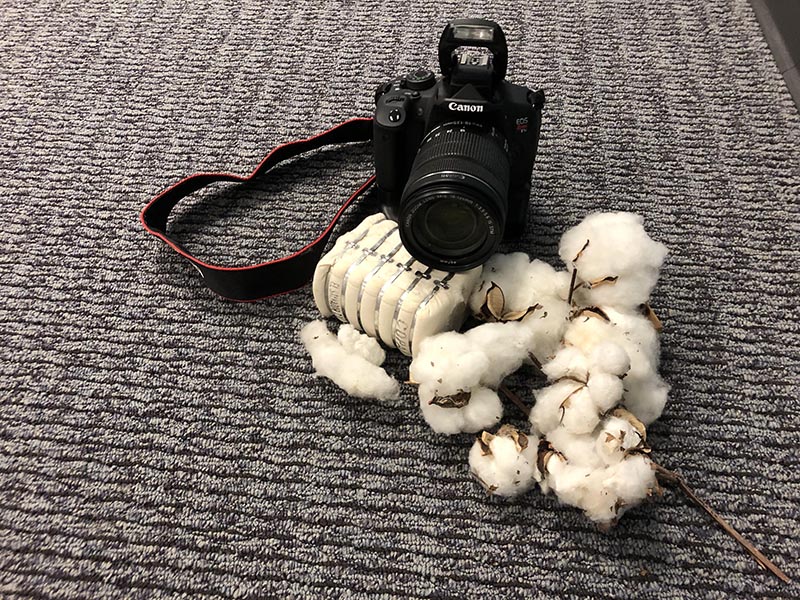
Una foto vale más que mil palabras – Tu foto puede llevarte a Ginebra para asistir al Dia Mundial del Algodón en la sede de la OMC.
Por qué: La fotografía es un poderoso medio de expresión que puede usarse para comunicar fuertes mensajes positivos. Este concurso fotográfico abierto y gratuito busca inspirar la creación y difusión de imágenes tan positivas, que transmita la importancia de una cadena de valor global sostenible.
Qué: el concurso fotográfico WCD (por sus siglas en inglés) está abierto a todos en la cadena de valor del algodón, desde los productores hasta los productos terminados. El concurso incluye cuatro categorías para cada una de las cuales habrá un ganador y un finalista.
Las categorías son:
‘Desde el Campo’: Esta categoría incluye todo en una granja normal, desde la siembra hasta cuando la fibra sale de la granja.
“Hacia la Fibra”: Esta categoría comienza en el desmote e incluye desmote, logística, control, hilado y comercio: todo lo que sucede desde el desmote hasta el producto final.
‘Hecho con Algodón’: Esta categoría abarca todos los productos finales hechos de la planta de algodón, no solo la fibra sino también tallos, aceite de semilla de algodón y varios subproductos de algodón.
‘Mujeres en Algodón’: Esta cubre toda la cadena de suministro de algodón y se centra en el papel fundamental que desempeñan las mujeres en la cadena de valor del algodón y los textiles.
REGLAS DEL CONCURSO
El concurso está abierto a participantes de todos los niveles de habilidad.
Cada individuo solo puede ganar una categoría.
Las fotografías pueden ser tomadas desde cualquier tipo de cámara.
Los fotógrafos conservan todos los derechos de autor de sus imágenes.
Los organizadores del Concurso fotográfico del Día Mundial del Algodón se reservan el derecho de publicar las fotografías del concurso en cualquier formato para felicitar o presentar a los ganadores y sus respectivas imágenes, y para promover futuros eventos del Día Mundial del Algodón, así como con fines de sensibilización.
Las imágenes ganadoras se incluirán en un comunicado de prensa y se publicarán en el sitio web y en las publicaciones impresas.
RESTRICCIONES SOBRE IMÁGENES MANIPULADAS
Se permite la manipulación de las imágenes. Esto incluye ajustes globales de exposición, contraste, saturación, recorte, nitidez, reducción de ruido y tono.
Se permite la limpieza menor de imágenes, incluida la eliminación de retro dispersión, marcas de polvo y arañazos.
También se permite Alto Rango Dinámico (HDR por sus siglas en ingles), panorámicas, apilamiento de enfoque y otras técnicas que involucran el uso de múltiples imágenes tomadas al mismo tiempo y lugar.
Sin embargo, aunque se permite la manipulación digital, tenga en cuenta que esto no es una competencia de Photoshop. Todas las imágenes deben representar con precisión la temática y la naturaleza del sujeto. Las imágenes que parezcan estar excesivamente procesadas pueden ser descalificadas a discreción de los jueces.
PAUTAS PARA LA PRESENTACIÓN DE FOTOS
Las fotografías deben enviarse por correo electrónico a wcd@icac.org (el tamaño máximo de archivo es de 5 MB). Las imágenes ganadoras se anunciarán y reconocerán formalmente el 7 de octubre de 2019 durante el lanzamiento del Día Mundial del Algodón.
Las fotos deben guardarse en formato JPEG y deben tener un tamaño entre 2000 y 6000 píxeles en la dimensión más larga.
Los individuos solo pueden enviar una fotografía por categoría.
Los participantes deben conservar los archivos de alta resolución y formato RAW, si corresponde, de sus presentaciones. En el caso de que su envío sea seleccionado como ganador, se le pedirá que envíe una imagen de alta resolución para imprimir y mostrar, y, si corresponde, una imagen RAW para verificar si los ajustes realizados a la imagen cumplen con las reglas.
CALENDARIO Y DURACIÓN
El concurso estará abierto del 8 de julio al 9 de septiembre de 2019, y los ganadores serán anunciados oficialmente durante la ceremonia de lanzamiento en la sede de la OMC en Ginebra.
JURADO
Los fotógrafos serán evaluados por un panel de varias agencias junto con un experto técnico. Esto es para asegurar que el contenido cumpla con las pautas descritas. Las fotos serán evaluadas en los siguientes criterios:
Originalidad y estilo.
Creatividad / atractivo visual,
Amplitud hasta donde la fotografía capta la esencia del tema, y
La fotografía debe cumplir con las pautas, términos y condiciones del concurso.
IMÁGENES GANADORAS
Las imágenes ganadoras formarán parte de una exposición informativa en la que las fotos se combinarán con narrativas que explicarán la importancia de una cadena de valor de algodón global sostenible, que llame la atención de los cientos de millones de personas en todo el mundo que se ganan la vida con su trabajo en la industria del algodón.
El Director General de la OMC y el Director Ejecutivo del CCIA entregaran certificados a los ganadores durante la ceremonia oficial durante la ceremonia de lanzamiento.
Las fotografías ganadoras se imprimirán y exhibidas en Ginebra.
PARA MAYOR INFORMACIÓN sobre el Día Mundial del Algodón, por favor haga clic aquí.
 Dr Mansurbek Muminov is a senior scientist at the Scientific Research Institute of Fiber Crops in Uzbekistan. His efforts have focused on basic cotton ginning and spinning, and he has authored more than 10 comprehensive research papers in those areas.
 Dr. Keshav R. Kranthi, Ph.D is the Chief Scientist at the International Cotton Advisory Committee (ICAC), Washington, DC. Before joining the ICAC, he served as the Director of the Central Institute for Cotton Research (CICR) in Nagpur, India, from 2008 to 2017. Dr. Kranthi has thirty-five years of experience as a cotton scientist. He received a gold medal in his Ph.D. in 1991 and has been honored with more than a dozen awards, including the Best CPP Program Award for Research Leadership by the Renewable Natural Resources Research International, UK; the ICAC Researcher of the Year Award in 2009; the Vasantrao Naik Smruti Pratisthan Award in 2004; the ICAR National Award for Leader of Best Team Research in 2006; Fellow of the National Academy of Agricultural Sciences in 2009; the ISCI Recognition Award in 2010; Krishi Gaurav Award in 2010; Bhumi Nirman Award in 2011; ISCI Fellow in 2017; the Plant Protection Recognition Award in 2016 by the National Academy of Agricultural Sciences; Suresh Kotak Global Cotton Award in 2023 and the CRDA life time achievement Award in 2024. Dr. Kranthi has four patents granted in South Africa, Mexico, China, and Uzbekistan, and six patent applications in India. He has published more than 100 peer-reviewed research papers, 20 books/handbooks/manuals, 17 book chapters, and more than 50 popular articles. Dr. Kranthi has presented invited talks and conducted training sessions in more than 40 countries. His research citations are in excess of 6,500. As the chief principal investigator, he coordinated and led more than 35 externally funded international collaboration research projects.
 Dr. Charudatta Mayee, Ph.D is a distinguished Indian agricultural scientist and administrator with over five decades of contributions to Indian agriculture. Dr. Mayee currently serves as Adjunct Professor at IARI, New Delhi, and several ICAR institutions and universities. Dr Mayee served as Vice Chancellor of MAU Parbhani, Director of the Central Institute for Cotton Research (ICAR-CICR), Nagpur, and Agriculture Commissioner for the Government of India. Dr Mayee served as Vice President of the National Academy of Agricultural Sciences (NAAS) India. Dr. C.D. Mayee has received numerous accolades spanning five decades, recognizing his transformative contributions to agricultural science. He is an Alexander von Humboldt Fellow and has received lifetime achievement awards from multiple institutions. His early career was marked by the Prof. M.J. Narasimhan Academic Award (1974) and V.P. Gokhale Award (1998), followed by national honors like the Vasantrao Naik Krishi Award (2002), ICAR Outstanding Team Research Award (2003), and Dr. B. Vishwanath Award (2005). He received Lifetime Achievement Awards from the Indian Society for Cotton Improvement (2008), National Academy of Agricultural Sciences (2011), and Indian Phytopathological Society (2017), among others. Four universities conferred Honorary Doctorates (D.Sc.) for his pioneering work (2009–2023). Recent distinctions include the Best Cotton Scientist Award (2022, Cotton Association of India), Krishi Maharshi for Cotton R&D (2024) and the winner of the ICAC Researcher of the Year Award 2025.
 Dr. Khalid Mahmood is the Co-Founder of SAWiE, where he has been instrumental in developing digital farm advisory and farm data platforms supporting over 10,000 farmers in Pakistan, improving traceability and transparency across agricultural supply chains. He is leading the development of first-mile traceability systems and the TRUE Cotton platform, connecting farmers with sustainable global textile supply chains.
 Dr Olivier Zieschank studied Management at the university of Lausanne, where he graduated in 2005. Until 2010, he worked in a Swiss-based start-up that specialized in negotiating cell tower lease agreements, where he became associate director. In 2010, he returned to university and studied applied economics in Neuchatel, Switzerland. He wrote his PhD in Economics at the University of Freiberg, Germany, where he developed a theory of organization. Mr Zieschank was appointed Economist at the ITMF in August 2017 and became director in January 2021.
 Ashwin Chandran holds a Bachelors Degree in Textile Technology from UMIST, UK and a Masters degree in Business Administration from the University of Illinois, USA.
 Mr. Shreyans Gupta is an officer of the Indian Revenue Service (IRS), currently serving as First Secretary at the Embassy of India in Washington D.C. In his current role, he oversees critical portfolios within the Income-tax Overseas Unit (ITOU) and the Commerce Wing, facilitating bilateral and multilateral cooperation.
 Eric Trachtenberg is the Executive Director of the International Cotton Advisory Committee (ICAC).
 Pia Terasa joined the textile machinery manufacturer Saurer over 25 years ago. She is responsible for marketing and communications at the group level. Coming originally from a non-textile background, market intelligence and business development have played major roles throughout her career. Her current main “hobby” is closely monitoring development of the textile recycling industry and circular economy.
 Dr. Md. Fakhre Alam Ibne Tabib is the former Executive Director of the Cotton Development Board of Bangladesh, with over 32 years of experience in cotton production, research, and development. He has demonstrated strong leadership and communication skills in engaging with national and international stakeholders in the cotton sector.
 Dr. Elsie Sia Kanza is the current Ambassador Extraordinary and Plenipotentiary of the United Republic of Tanzania to the United States of America and Mexico. Prior to that role, Ambassador Kanza served as Special Advisor to the President of the World Economic Forum, and, before that, Head of Africa and Member of Executive Committee for 10 years championing growth and development in Africa leveraging public private collaboration. In 2015, She was awarded a Doctorate in Business Administration (honoris causa) by the University of Strathclyde for the transformative impact achieved in Africa.
 Alison Ward has over 30 years of international experience in sustainability and corporate affairs. Alison is the CEO of CottonConnect, where she leads a team of over 100 employees, impacting the lives of over 800,000 cotton farmers in India, China, Pakistan, Turkey, Egypt and Bangladesh. Under Alison’s leadership the organization: drives supply chain transparency connecting sustainable fibres from farm to store; focuses on the rights and skills of women in supply chains through pioneering gender programmes; and continues to develop innovations at a farm level. She leads cotton strategies and programmes for global brands and retailers.


 Name: Mary Concilia Anchang
 Besim Özek
 SIDDHARTHA RAJAGOPAL, Executive Director – TEXPROCIL