Dr. Keshav Kranthi, Chief Scientist of the International Cotton Advisory Committee (ICAC) conducted a one-day practical training course on production of biochar at ESA-INP-HB, Yamoussoukro, Cote d’Ivoire on 13 April 2023 for staff of ESA, Olam Agri and Ivoire Coton. Recently the ICAC had conducted a three-days training course in the second week of March 2023 in Kushtia in Bangladesh for staff of Cotton Connect, Primark, CDB and ginners. Over the past two years, the ICAC conducted several practical training programs on a simple, low-cost technique to produce biochar from cotton stalks and other farm residues in Zambia, Cameroon, Burkina Faso and other countries. The technique, called the ‘cone-pit open earth kiln,’ is now being widely used by hundreds of farmers in Africa, and it is expected to spread in other countries, such as, Bangladesh where it is being promoted by Cotton Connect, by Solidaridad in Zambia, by Olam Agri and Ivoire Coton in Cote d’Ivoire and by Sodecoton in Cameroon and by several institutions in India.
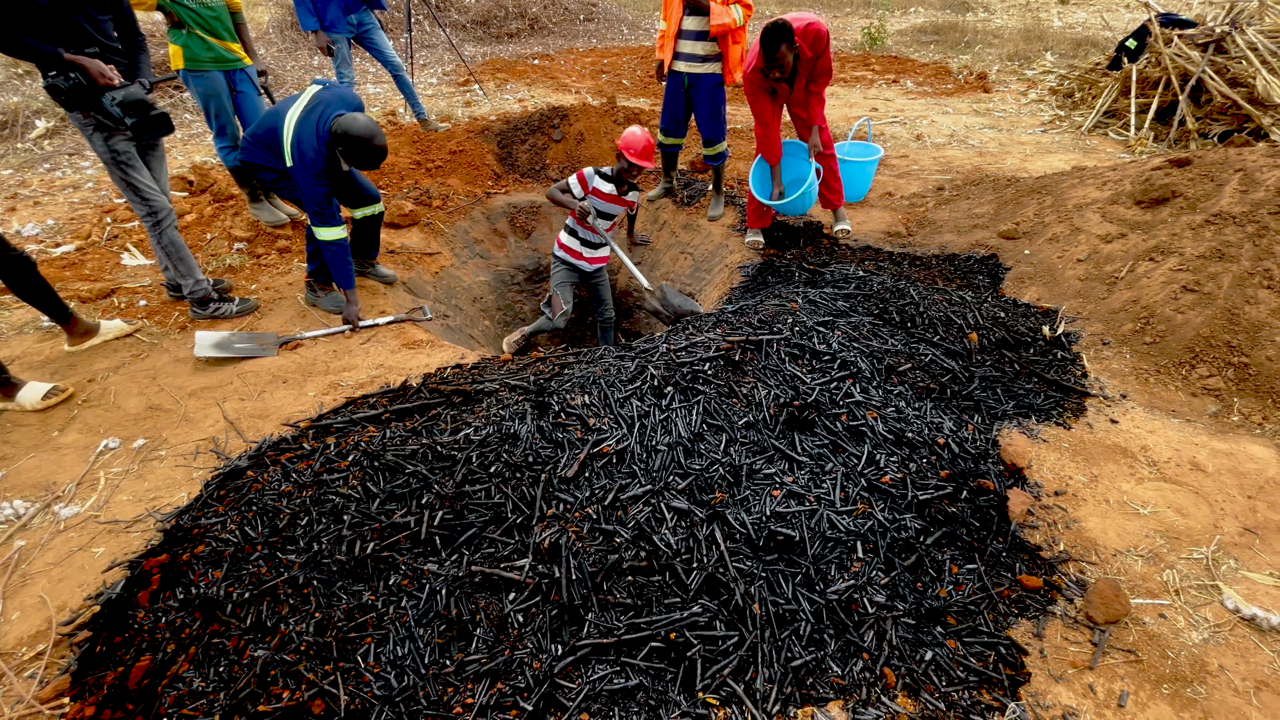
The ICAC scientists standardized the cone-pit open earth kiln technique for producing biochar from cotton stalks after being inspired by a path-breaking research paper authored by Schmidt and Taylor (2014). This technique was used in a project titled ‘Doubling small-farmer yields in Zambia,’ which was funded by the ITC-EU and implemented by CDT and CBZ in Zambia. Mr. Martin Simasiku, Mr. Lwisya Silwimba, Mr. Derrick Sichilima, Mr. Dafulin Kaonga, and Mr. Sunduzwayo Banda provided leadership for the initiative in Zambia.
The ICAC has recently initiated a project called ‘Adapting Innovations for Resilience to Climate Change for Smallholder Cotton Farmers (i4Ag-AIRCoA)’ carried out by ICAC and CIRAD on behalf of Deutsche Gesellschaft fur Internationale Zusammenarbeit (GIZ) GmbH through the “Innovation for Agriculture” (i4Ag) Program, funded and commissioned by the German Federal Ministry for Economic Cooperation and Development (BMZ) to produce biochar and use it in regenerative agriculture to enhance yields in at least 4,800 demonstration fields of one acre each in Cameroon and Cote d’Ivoire during three years from December 2022 to December 2025. The project aims to promote the use of biochar as a sustainable soil amendment and carbon sequestration tool while enhancing the resilience of smallholder cotton farmers to climate change.
According to preliminary results from the ICAC initiatives, biochar produced from cotton stalks was found to be highly alkaline and can effectively remediate acidic soils, improve soil structure, enhance cation exchange capacity, and enrich soil health by adding organic carbon. Although acidic soils can benefit directly from alkaline biochar, the addition of organic matter and manure can further assist in enhancing soil health without the risk of nutrient lockup caused by biochar. In addition to promoting the use of alkaline biochar, the ICAC is also encouraging the adoption of technologies to produce high-quality, nitrogen-rich compost. This can be achieved through aerated matrices using biochar or through an unaerobic process called ‘Bokashi,’ which can produce acidic compost from organic matter within 2-3 weeks and neutralize alkaline biochar, resulting in the quickest possible enrichment of soil organic matter.
 Dr Mansurbek Muminov is a senior scientist at the Scientific Research Institute of Fiber Crops in Uzbekistan. His efforts have focused on basic cotton ginning and spinning, and he has authored more than 10 comprehensive research papers in those areas.
 Dr. Keshav R. Kranthi, Ph.D is the Chief Scientist at the International Cotton Advisory Committee (ICAC), Washington, DC. Before joining the ICAC, he served as the Director of the Central Institute for Cotton Research (CICR) in Nagpur, India, from 2008 to 2017. Dr. Kranthi has thirty-five years of experience as a cotton scientist. He received a gold medal in his Ph.D. in 1991 and has been honored with more than a dozen awards, including the Best CPP Program Award for Research Leadership by the Renewable Natural Resources Research International, UK; the ICAC Researcher of the Year Award in 2009; the Vasantrao Naik Smruti Pratisthan Award in 2004; the ICAR National Award for Leader of Best Team Research in 2006; Fellow of the National Academy of Agricultural Sciences in 2009; the ISCI Recognition Award in 2010; Krishi Gaurav Award in 2010; Bhumi Nirman Award in 2011; ISCI Fellow in 2017; the Plant Protection Recognition Award in 2016 by the National Academy of Agricultural Sciences; Suresh Kotak Global Cotton Award in 2023 and the CRDA life time achievement Award in 2024. Dr. Kranthi has four patents granted in South Africa, Mexico, China, and Uzbekistan, and six patent applications in India. He has published more than 100 peer-reviewed research papers, 20 books/handbooks/manuals, 17 book chapters, and more than 50 popular articles. Dr. Kranthi has presented invited talks and conducted training sessions in more than 40 countries. His research citations are in excess of 6,500. As the chief principal investigator, he coordinated and led more than 35 externally funded international collaboration research projects.
 Dr. Charudatta Mayee, Ph.D is a distinguished Indian agricultural scientist and administrator with over five decades of contributions to Indian agriculture. Dr. Mayee currently serves as Adjunct Professor at IARI, New Delhi, and several ICAR institutions and universities. Dr Mayee served as Vice Chancellor of MAU Parbhani, Director of the Central Institute for Cotton Research (ICAR-CICR), Nagpur, and Agriculture Commissioner for the Government of India. Dr Mayee served as Vice President of the National Academy of Agricultural Sciences (NAAS) India. Dr. C.D. Mayee has received numerous accolades spanning five decades, recognizing his transformative contributions to agricultural science. He is an Alexander von Humboldt Fellow and has received lifetime achievement awards from multiple institutions. His early career was marked by the Prof. M.J. Narasimhan Academic Award (1974) and V.P. Gokhale Award (1998), followed by national honors like the Vasantrao Naik Krishi Award (2002), ICAR Outstanding Team Research Award (2003), and Dr. B. Vishwanath Award (2005). He received Lifetime Achievement Awards from the Indian Society for Cotton Improvement (2008), National Academy of Agricultural Sciences (2011), and Indian Phytopathological Society (2017), among others. Four universities conferred Honorary Doctorates (D.Sc.) for his pioneering work (2009–2023). Recent distinctions include the Best Cotton Scientist Award (2022, Cotton Association of India), Krishi Maharshi for Cotton R&D (2024) and the winner of the ICAC Researcher of the Year Award 2025.
 Dr. Khalid Mahmood is the Co-Founder of SAWiE, where he has been instrumental in developing digital farm advisory and farm data platforms supporting over 10,000 farmers in Pakistan, improving traceability and transparency across agricultural supply chains. He is leading the development of first-mile traceability systems and the TRUE Cotton platform, connecting farmers with sustainable global textile supply chains.
 Dr Olivier Zieschank studied Management at the university of Lausanne, where he graduated in 2005. Until 2010, he worked in a Swiss-based start-up that specialized in negotiating cell tower lease agreements, where he became associate director. In 2010, he returned to university and studied applied economics in Neuchatel, Switzerland. He wrote his PhD in Economics at the University of Freiberg, Germany, where he developed a theory of organization. Mr Zieschank was appointed Economist at the ITMF in August 2017 and became director in January 2021.
 Ashwin Chandran holds a Bachelors Degree in Textile Technology from UMIST, UK and a Masters degree in Business Administration from the University of Illinois, USA.
 Mr. Shreyans Gupta is an officer of the Indian Revenue Service (IRS), currently serving as First Secretary at the Embassy of India in Washington D.C. In his current role, he oversees critical portfolios within the Income-tax Overseas Unit (ITOU) and the Commerce Wing, facilitating bilateral and multilateral cooperation.
 Eric Trachtenberg is the Executive Director of the International Cotton Advisory Committee (ICAC).
 Pia Terasa joined the textile machinery manufacturer Saurer over 25 years ago. She is responsible for marketing and communications at the group level. Coming originally from a non-textile background, market intelligence and business development have played major roles throughout her career. Her current main “hobby” is closely monitoring development of the textile recycling industry and circular economy.
 Dr. Md. Fakhre Alam Ibne Tabib is the former Executive Director of the Cotton Development Board of Bangladesh, with over 32 years of experience in cotton production, research, and development. He has demonstrated strong leadership and communication skills in engaging with national and international stakeholders in the cotton sector.
 Dr. Elsie Sia Kanza is the current Ambassador Extraordinary and Plenipotentiary of the United Republic of Tanzania to the United States of America and Mexico. Prior to that role, Ambassador Kanza served as Special Advisor to the President of the World Economic Forum, and, before that, Head of Africa and Member of Executive Committee for 10 years championing growth and development in Africa leveraging public private collaboration. In 2015, She was awarded a Doctorate in Business Administration (honoris causa) by the University of Strathclyde for the transformative impact achieved in Africa.
 Alison Ward has over 30 years of international experience in sustainability and corporate affairs. Alison is the CEO of CottonConnect, where she leads a team of over 100 employees, impacting the lives of over 800,000 cotton farmers in India, China, Pakistan, Turkey, Egypt and Bangladesh. Under Alison’s leadership the organization: drives supply chain transparency connecting sustainable fibres from farm to store; focuses on the rights and skills of women in supply chains through pioneering gender programmes; and continues to develop innovations at a farm level. She leads cotton strategies and programmes for global brands and retailers.


 Name: Mary Concilia Anchang
 Besim Özek
 SIDDHARTHA RAJAGOPAL, Executive Director – TEXPROCIL